FiveScribe
HIPAA-compliant contextual augmentation platform for Medicaid caregivers, reducing report generation time from 30 minutes to under 2 minutes while maintaining regulatory compliance.
The Challenge
Medicaid caregivers spend 30+ minutes per client session manually writing detailed progress notes, interventions, and compliance documentation. This administrative burden reduces time available for actual patient care and creates bottlenecks in billing cycles. The documentation must meet strict HIPAA requirements and Medicaid audit standards while remaining affordable for small healthcare agencies.
The Solution
FiveScribe is a production-ready SaaS platform that transforms caregiver voice notes and observations into compliant Medicaid documentation in under 2 minutes. Built on AWS serverless infrastructure with advanced contextual augmentation, the system provides enterprise-grade security at startup-friendly pricing.
Product Walkthrough
Dashboard Overview
Clean, accessible interface showing recent reports, quick actions, and usage summary. Built with Next.js, React 19, and Tailwind CSS with full keyboard navigation support.
Generate a Care Note
Transform raw caregiver observations into structured Medicaid documentation in under 2 seconds. The system generates interventions, participant responses, progress notes, and next steps—all formatted for compliance.
Client Management
Full CRUD for client records with Medicaid ID tracking, goals management, and historical report access.
Reports & Compliance
Browse completed notes, review compliance status, and export documentation for Medicaid audits with a 6-year retention trail.
Usage & Billing
Real-time usage dashboard showing reports generated, tokens consumed, and remaining quota. Integrated with Stripe for seamless plan upgrades and billing management.
Analytics infrastructure behind the application
FiveScribe included a compact healthcare analytics stack to move production data out of DynamoDB, land it in S3, model it in Snowflake with dbt, and expose trustworthy reporting for usage, billing, and operational oversight.
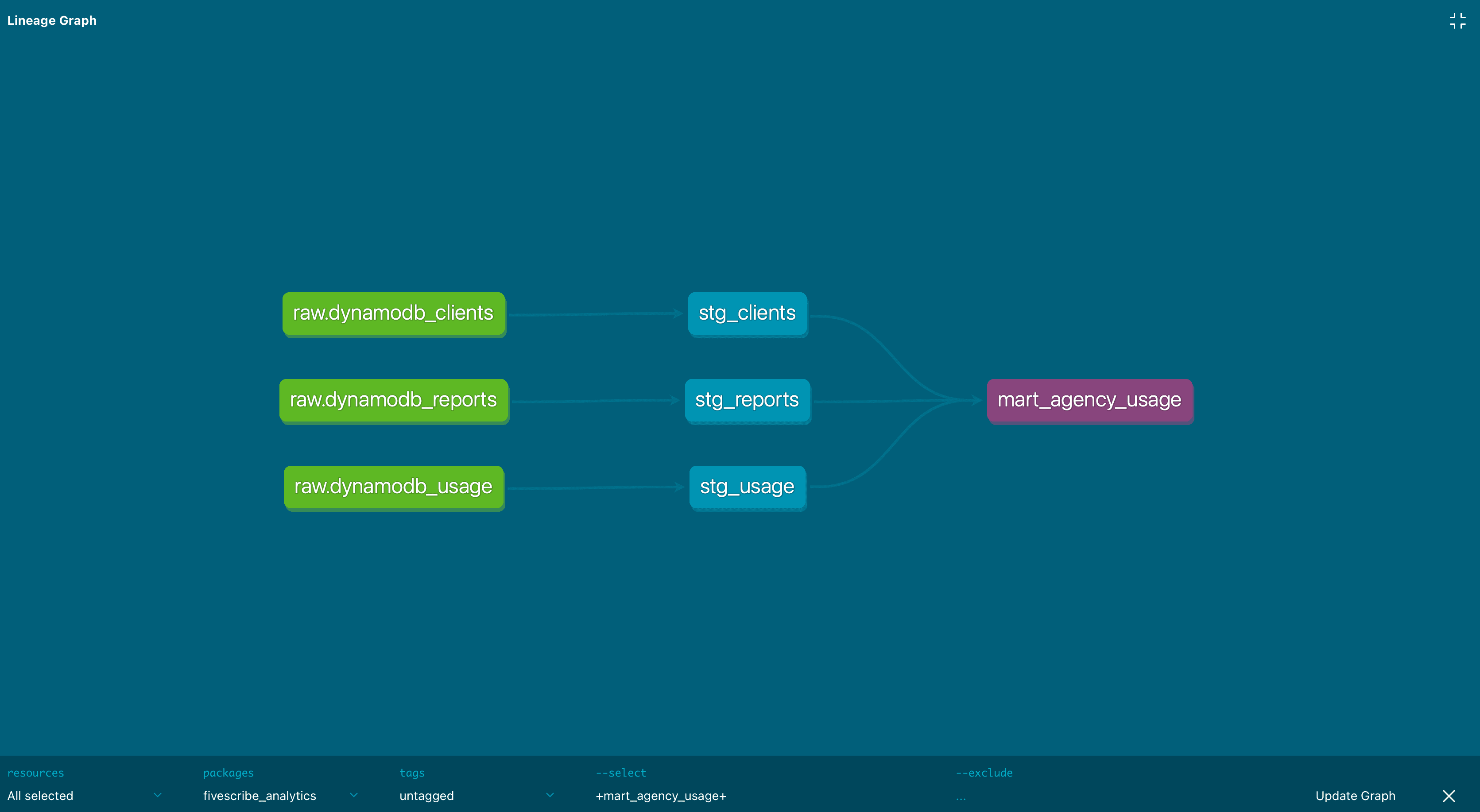
Operational DynamoDB exports are modeled through bronze, silver, and gold layers to produce agency usage, client visit history, and cost analysis tables.
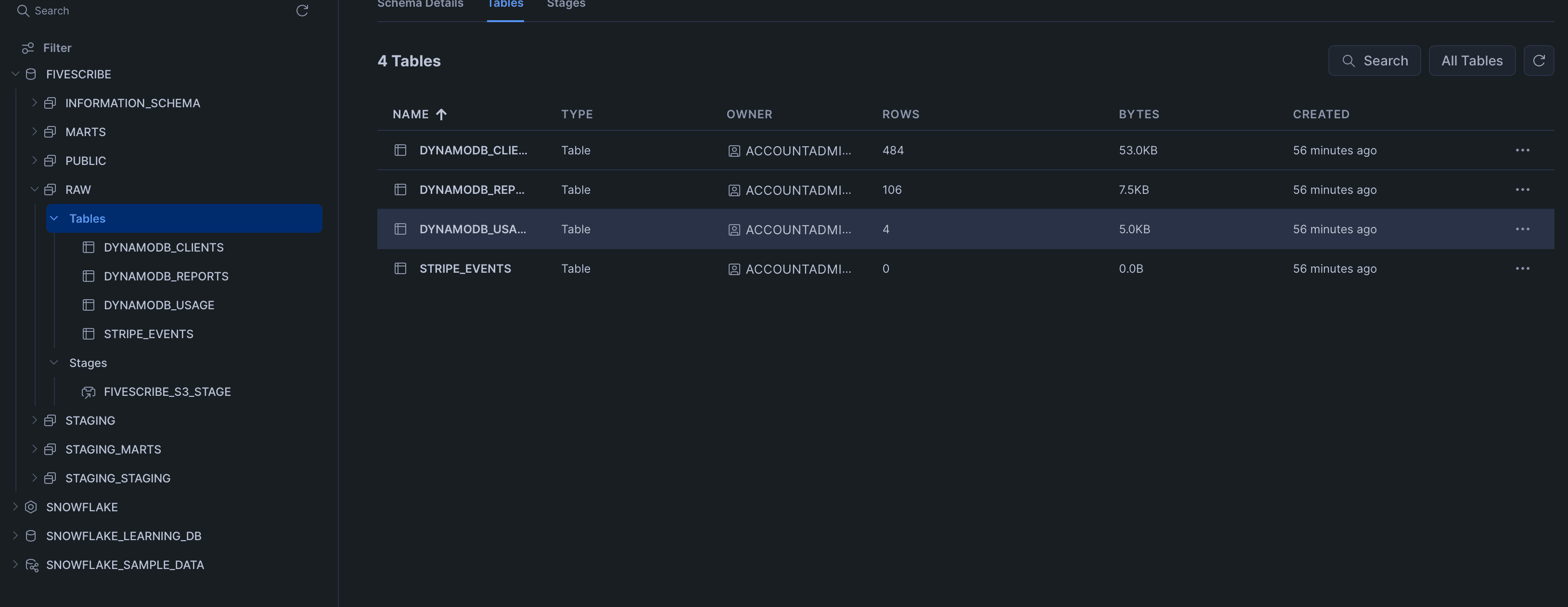
The warehouse keeps raw JSON isolated, typed staging views clean, and analytics-ready marts separate so finance, operations, and compliance reporting stay auditable.
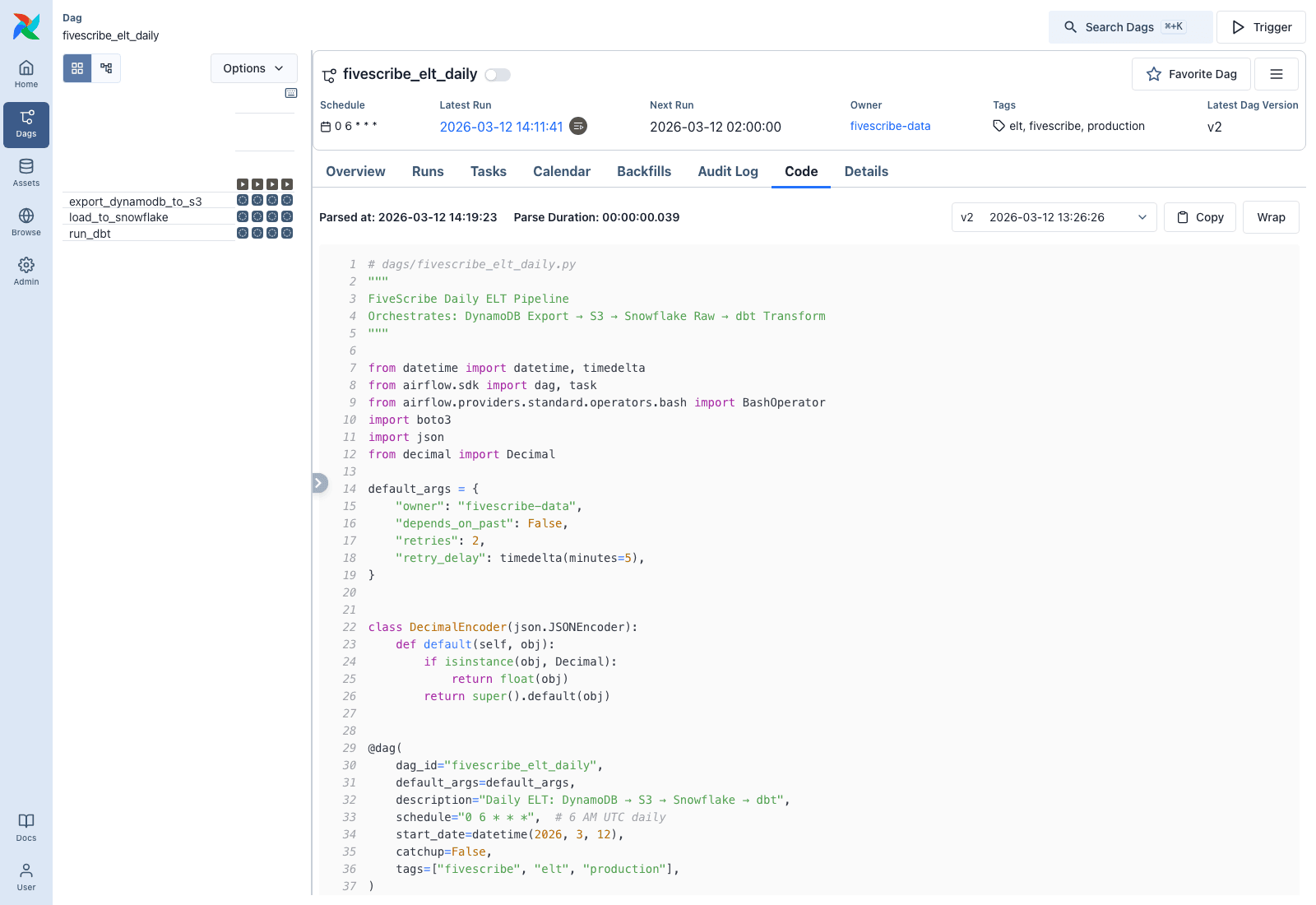
A compact Airflow DAG moves data from export to load to dbt run/test, giving the platform deterministic refreshes without adding heavy operational overhead.
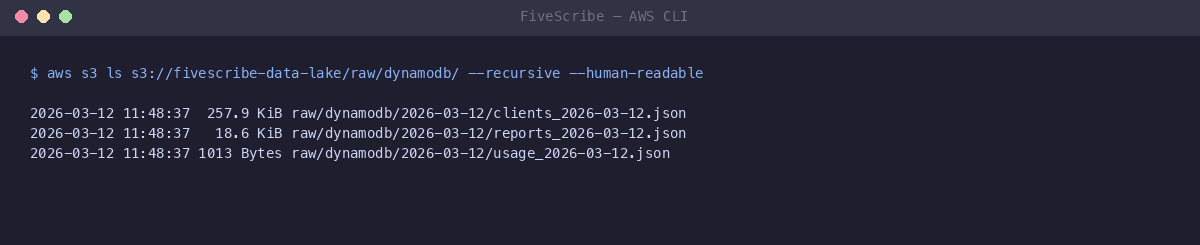
Raw NDJSON extracts land in S3 before warehouse loading, creating a low-cost replay point for debugging, backfills, and downstream compliance evidence.
Technical Architecture
- • Lambda (6 functions)
- • API Gateway (REST)
- • CloudWatch Logs
- • DynamoDB (3 tables)
- • S3 (reports + assets)
- • SSM Parameter Store
- • Cognito User Pool
- • IAM roles & policies
- • KMS encryption
User Request → API Gateway → Cognito Auth → Lambda
                                               │
                                               ├─ 1. Check usage limits
                                               │     └─ DynamoDB atomic read
                                               │
                                               ├─ 2. Call contextual augmentation API
                                               │     └─ Report generation
                                               │
                                               ├─ 3. Record usage
                                               │     └─ DynamoDB atomic increment
                                               │
                                               └─ 4. Return report + metadata
Key Features & Implementation
Implemented atomic DynamoDB counters for deterministic cost control. Each report generation tracks prompt tokens, completion tokens, and total usage against tier-based monthly limits.
- • Pre-request usage gating prevents overages
- • Atomic DynamoDB UpdateItem prevents race conditions
- • Billing period auto-resets monthly (YYYY-MM format)
- • Real-time quota enforcement with 429 responses
Built from the ground up with healthcare compliance requirements. All PHI is encrypted at rest and in transit, with comprehensive audit logging and access controls.
- ✓ DynamoDB AWS-managed encryption
- ✓ S3 SSE-S3 encryption
- ✓ TLS 1.2+ for all API calls
- ✓ SSM SecureString (KMS)
- ✓ Cognito JWT authentication
- ✓ IAM least-privilege policies
- ✓ User data isolation (userId scoping)
- ✓ S3 public access blocked
- • CloudWatch logs for all Lambda executions
- • S3 versioning for immutable audit trail
- • DynamoDB point-in-time recovery (35 days)
- • BAA-eligible AWS services only
Cost Structure & Economics
Results & Impact
Implementation Highlights
Critical Technical Decisions
- • Premium model: $10/$30 per 1M tokens
- • Cost per report: $0.067
- • Gross margin: 85%
- • Response time: 3-5 seconds
- • Optimized model: $0.15/$0.60 per 1M tokens
- • Cost per report: $0.001
- • Gross margin: 99%+
- • Response time: 1-2 seconds
For structured template-based generation with clear instructions, the optimized model produces identical quality. The key was testing before assuming the expensive option was necessary.
- • Base cost: $50+/month
- • Always-on compute
- • Manual scaling
- • Connection pooling required
- • Base cost: $3/month
- • Pay-per-use
- • Automatic scaling
- • Zero idle costs
Cold starts are 100ms without VPC, 1-2s with VPC. For our use case (user-initiated report generation), this latency is acceptable. The cost savings far outweigh the minor UX impact.
VPC isolation provides network security but adds $32/month for NAT Gateway. Not all customers need this—only those with private databases or strict compliance requirements.
Built complete VPC infrastructure with Flow Logs and VPC endpoints, but gated deployment behind a feature flag. Zero cost when disabled, easy to enable when needed.